

 By
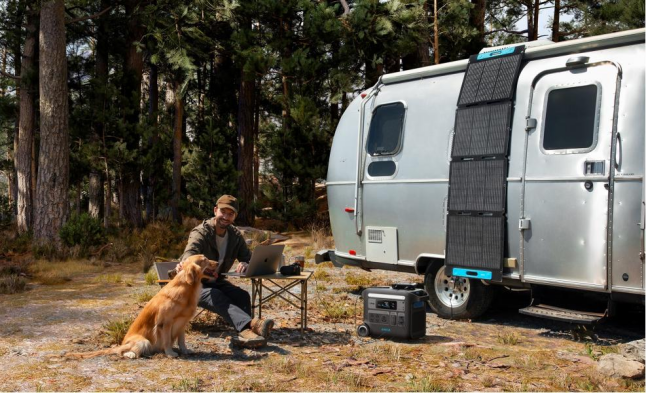
By Staying connected while camping, traveling in an RV, or spending time outdoors no longer has to mean rationing battery life. Folding solar panels have become a popular solution for powering devices off-grid, promising convenience and renewable energy in a portable form. Still, many people wonder whether these panels can actually charge devices efficiently or if they are only suitable for emergencies. To answer that question, it’s important to look at how folding solar panels deliver power and what affects their real-world performance.
How Efficiently Do Folding Solar Panels Power Your Devices?
Understanding the efficiency of folding solar panels requires examining how they generate electricity, deliver it to devices, and adapt to outdoor conditions.
High-Efficiency Solar Cell Technology
Modern folding solar panels are far more efficient than many people expect. Most use monocrystalline solar cells, which are known for their high energy conversion rates. Many portable panels now reach efficiencies of up to 23%, allowing them to produce strong output even from a compact surface area. Anker SOLIX folding solar panels, for example, are designed to deliver faster charging times by capturing and converting more sunlight throughout the day. This means devices can charge more quickly compared to older or lower-quality solar panels.
Direct Device Charging vs. Power Station Charging
Efficiency also depends on how devices are charged. Smaller folding solar panels often include USB-A and USB-C ports, enabling direct charging of smartphones, tablets, cameras, and power banks. This setup minimizes energy loss and is ideal for lightweight outdoor use. Larger folding solar panels are typically paired with portable power stations, which store solar energy and regulate output. While this adds a conversion step, it allows consistent and efficient charging of multiple devices, even when sunlight fluctuates.
Adjustable Angles for Maximum Sunlight Capture
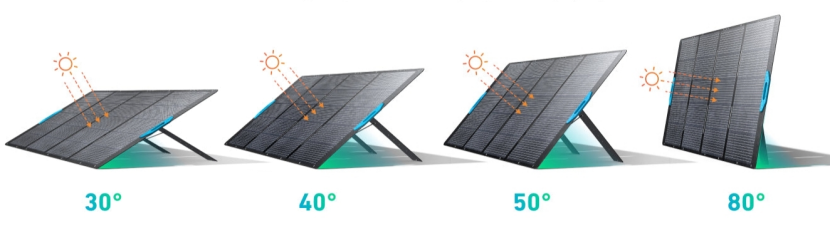
One of the reasons folding solar panels perform efficiently outdoors is their adjustable design. Many models feature built-in stands that allow users to tilt the panel at different angles, like 30°, 40°, 50°, or 80°. This flexibility helps align the panel with the sun’s position, significantly improving power output. Compared to flat or fixed panels, adjustable folding panels can generate noticeably more energy over the course of a day, directly improving charging efficiency.
Stable Connections and Reduced Energy Loss
Charging efficiency is not just about solar cells; it also depends on how power is transferred. Quality folding solar panels use reliable connectors, such as MC4 connectors, which provide stable, low-resistance connections. These connectors help minimize energy loss between the panel and the power station or device. Some panels also include multiple adapters, making it easier to connect to various power stations without compromising efficiency.
Performance in Real Outdoor Conditions
Outdoor efficiency naturally varies with weather, location, and time of day. However, well-designed folding solar panels are built to perform consistently in real-world conditions. Durable surface coatings like ETFE help maximize light transmission, while weather-resistant or waterproof ratings allow panels to operate during light rain or damp conditions. This reliability ensures that devices continue charging safely and efficiently during extended outdoor trips.
Matching Panel Output to Device Needs
Efficiency improves when the solar panel’s output matches the power requirements of the devices being charged. Lower-wattage folding solar panels are efficient for phones and small electronics, while higher-wattage panels are better suited for laptops, power stations, and multiple devices at once. Choosing the right panel size ensures optimal charging speeds without wasted capacity.
Conclusion
So, folding solar panels can charge devices efficiently when designed with modern solar technology and used correctly. High conversion efficiency, adjustable positioning, stable connections, and smart pairing with power stations all contribute to reliable charging performance. While sunlight conditions always play a role, quality folding solar panels, such as those in the Anker SOLIX lineup, offer practical and efficient power solutions for campers, travelers, and anyone seeking off-grid convenience to keep devices powered wherever they go.